
Endocrine Disruptors and Menopause: How to Reduce Your Exposure
When we talk about menopause, we quite rightly talk about changing levels of oestrogen.
But our own hormones are not the only substances capable of interacting with the body’s hormonal system.
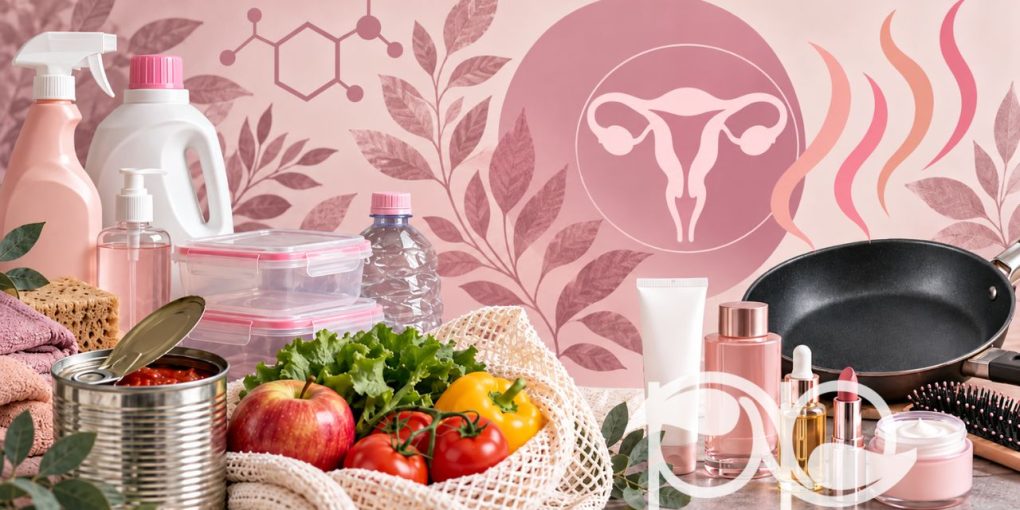
We are surrounded by man-made chemicals in everyday life, from food packaging and cookware to cosmetics, household products, textiles and the wider environment. Some of these are known as endocrine-disrupting chemicals, or EDCs.
You’re not alone if you have never heard much about them.
Yet as women move through perimenopause and menopause, I believe it is worth understanding what these chemicals are, where we may encounter them, and the simple steps we can take to reduce our exposure.
This is not about becoming frightened of everything around you or trying to live in a chemical-free bubble. That simply isn’t realistic.
It is about becoming more informed and making manageable changes where you can.
Prefer to watch? In this video, I explain why endocrine disruptors may matter during menopause and the practical steps you can take to reduce your exposure.
Or listen to the audio podcast.
What are Endocrine Disruptors (EDCs)?

The Endocrine Society explains endocrine-disrupting chemicals as chemicals that can mimic, block or interfere with hormones within the endocrine system.
Our endocrine system is the network responsible for producing and regulating hormones throughout the body.
Some endocrine disruptors can interfere particularly with oestrogen signalling. These are sometimes referred to as xenoestrogens, because they can act in an oestrogen-like way within the body.
But not all endocrine disruptors are xenoestrogens. EDCs can interfere with different hormones and hormonal processes.
And exposure is widespread.
Some EDCs are persistent, which means they remain in the environment and body for long periods. Others, such as BPA and some phthalates, do not remain for as long, but because we may encounter them repeatedly through everyday products, exposure can still be ongoing. A review specifically examining endocrine disruptors and menopause highlights how these chemicals can come from food, contaminated water, personal-care products, textiles and the wider environment.
Why Could Endocrine Disruptors Matter During Menopause?

During perimenopause and menopause, natural oestrogen production starts to decline.
Oestrogen normally locks onto receptors throughout the body and brain, rather like a key fitting into a lock. This helps explain why declining oestrogen can produce such a wide variety of menopausal symptoms.
Some endocrine-disrupting chemicals can interact with hormonal receptors or interfere with normal hormonal signalling.
Research in this area is continuing, but the evidence has developed considerably in recent years.
A 2023 review looking specifically at environmental chemicals and menopause reported associations between EDC exposure and earlier menopause, increased vasomotor symptoms such as hot flushes, altered steroid hormone levels and markers of reduced ovarian reserve.
More recently, a 2025 review of endocrine-disrupting chemicals and female reproductive health concluded that there is growing evidence linking EDC exposure with female reproductive health concerns, including premature menopause, while also recognising that proving direct cause and effect in humans can be difficult.
For me, this is another reason to think about our total chemical exposure as part of the wider menopause picture.
What Are Some Common Endocrine Disruptors?

There are many different endocrine-disrupting chemicals, but these are some of the groups you are most likely to hear about:
Bisphenol A (BPA) is found in many plastic products including food storage containers, cling film and in the lining of tin cans. It leaches into food and drink, especially if the plastic is warm.
Phthalates are a particularly nasty group of chemicals commonly found in toiletries, cosmetics and household cleaning products. They can also be found in some food packaging and children’s toys.
PFAS (Perfluoroalkyl and Polyfluoroalkyl Substances (PFAS) commonly found in non-stick pans and textile coatings.
Pesticides In 2019 the charity Friends of the Earth reported the increasing use of pesticides in the UK. There has been a 24% increase in pesticide use since 2000 with a growing list of chemicals.
PCBs (Polychlorinated biphenyls) from manufacturing that may leach into our water supplies.
The UK Government’s 2026 PFAS Plan describes PFAS as one of today’s significant chemical challenges because of their widespread use and persistence in the environment.
BPA and Food Packaging
BPA is probably one of the best-known endocrine-disrupting chemicals.
It has historically been used in various food-contact materials, including some plastic containers and protective linings inside food and drink cans.
This is also an area where regulation is changing.
The Food Standards Agency has been reviewing restrictions on BPA and related bisphenols in food-contact materials. Its latest guidance on BPA in food packaging explains that stricter EU rules now apply in Northern Ireland, while the legal position in Great Britain remains different as domestic policy develops.
From a practical perspective, I prefer not to heat food in plastic containers and choose glass, ceramic or stainless steel for hot foods wherever possible.
What About Phthalates?
Phthalates are another group I encourage women to become familiar with.
They may be found in certain plastics, fragrances, cosmetics and personal-care products.
Research has also looked specifically at phthalate exposure during the menopausal transition. Some studies have reported associations between higher exposure to certain phthalates and menopausal symptoms, including hot flushes.
This does not mean that one cosmetic product or one exposure is responsible for your symptoms.
It is the wider pattern of repeated exposure that interests me.
I choose natural skincare and toiletries where possible and look carefully at the ingredients in products I use regularly.
You do not have to replace everything in your bathroom overnight. Start with the products you use most frequently and replace them as they run out.
That is a much more manageable approach.
Reduce Plastic Exposure Where You Can
Plastic is so embedded in modern life that avoiding it completely would be virtually impossible.
But there are some straightforward swaps.
I prefer carrying water in a stainless-steel or glass bottle rather than relying on disposable plastic bottles.
I also avoid reheating food in plastic containers, even if they are labelled microwave-safe, and use glass or ceramic containers instead.
The Endocrine Society’s practical guidance on reducing EDC exposure similarly recommends avoiding heating food in plastic and making informed choices about food containers and household products.
These are small changes, but once they become habit they require very little thought.
Think About Your Cookware
PFAS have historically been used because of their water-, grease- and heat-resistant properties, including in some non-stick cookware.
You do not necessarily need to throw every pan away tomorrow.
I would start by looking at the oldest and most scratched non-stick cookware and replacing it gradually with alternatives such as stainless steel, cast iron or suitable ceramic cookware.
Again, think gradual change rather than perfection.
Consider Your Food Choices
Food is another area where we can make informed choices.
The UK continues to monitor pesticide residues in food. In 2025, the national programme tested thousands of food and drink samples for hundreds of different pesticide residues.
For me, this does not mean becoming frightened of conventionally grown fruit and vegetables.
I would far rather somebody ate plenty of vegetables than avoided them because they could not afford organic.
But if reducing pesticide exposure is important to you, organic food can be one tool.
I’ve explained more about the health benefits of organic food and, importantly, how to choose organic food wisely without buying everything organic.
That allows you to prioritise where your budget will make the most difference.
Look at Your Wider Chemical Exposure

Food and plastics are only part of the picture.
Think about what you use on your skin, the fragrances in your home, laundry products, cleaning products, candles and air fresheners.
You cannot eliminate every exposure, and you do not need to.
The Endocrine Society itself recognises that we cannot control every chemical we encounter. The goal is to make more informed choices about the products we use most often.
I’ve also written more broadly about reducing your wider toxic load if you would like to explore this subject further.
Don’t Forget the Wider Menopause Picture
Endocrine disruptors are only one part of the menopause conversation.
Food, digestion, stress, sleep, movement and lifestyle all matter too.
The gut is particularly important because of the relationship between digestion, the microbiome and hormone metabolism.
You can read more about that connection in my article on gut health during menopause.
As with so many areas of health, I prefer to look at the whole person rather than one isolated factor.
Making a Manageable Plan of Action

The most important thing is not to become overwhelmed.
Take a look around your everyday life and ask yourself where your greatest regular exposures might be.
Perhaps you heat food in plastic containers every day. Maybe you use lots of fragranced toiletries and cleaning products. Your oldest non-stick pans might be scratched and ready to replace. Or perhaps food is the easiest place for you to begin.
Choose one or two changes first.
Replace things gradually.
There is no benefit in creating another source of stress by feeling that you have to overhaul your entire home immediately.
Small, consistent changes are much more realistic.
Final Thought
We cannot completely avoid endocrine-disrupting chemicals. They are part of our modern environment.
But that does not mean we are powerless.
Understanding where they are commonly found allows us to make better choices about the things we eat, drink, cook with, put on our skin and bring into our homes.
And for women moving through perimenopause and menopause, I believe this is particularly worth considering as part of the wider hormonal health picture.
Start with what feels manageable.
Perhaps change your water bottle, stop heating food in plastic, replace an old non-stick pan or gradually switch the toiletries you use most frequently.
You do not need to do everything today.
If you are struggling with menopausal symptoms and are unsure how your diet, digestion and wider lifestyle may be affecting how you feel, you are very welcome to book a free 20-minute discovery call.
We can talk through what is going on and whether my naturopathic approach may be right for you.
Caroline x

FAQs
What are endocrine disruptors?
Endocrine disruptors are chemicals that can interfere with the body’s hormonal system. They may mimic hormones, block their action or interfere with normal hormone signalling.
Can endocrine disruptors affect menopause?
Research has found associations between exposure to certain endocrine-disrupting chemicals and areas including earlier menopause, hot flushes, hormone levels and ovarian ageing. Research is continuing to understand these relationships more fully.
Where are endocrine disruptors commonly found?
They may be found in some plastics, food packaging, cosmetics, fragrances, personal-care products, pesticides, non-stick coatings, textiles and other everyday materials.
What are xenoestrogens?
Xenoestrogens are external substances that can behave in an oestrogen-like way in the body. Some endocrine-disrupting chemicals can act as xenoestrogens, although not all EDCs work through oestrogen.
How can I reduce my exposure to endocrine disruptors?
Start with simple changes such as avoiding heating food in plastic, using glass or stainless-steel alternatives where possible, replacing damaged non-stick cookware, washing fruit and vegetables, choosing toiletries carefully and reducing unnecessary synthetic fragrances.
Do I need to buy everything organic?
No. If cost is a concern, prioritise foods you eat frequently or produce more likely to carry pesticide residues. Eating plenty of varied, whole foods remains more important than trying to make every item organic.

Join my free Health Lifestyle & Nutrition Facebook Group. A wonderful group where you can get help, advice, support and tips to help make the right lifestyle and nutrition choices for you.
Follow me on Social Media for the latest in Natural Health…
Facebook https://www.facebook.com/peytonprinciples
Instagram https://www.instagram.com/peytonprincipleshealth/
Twitter https://twitter.com/carolinepy
LinkedIn https://www.linkedin.com/company/peyton-principles-natural-health/